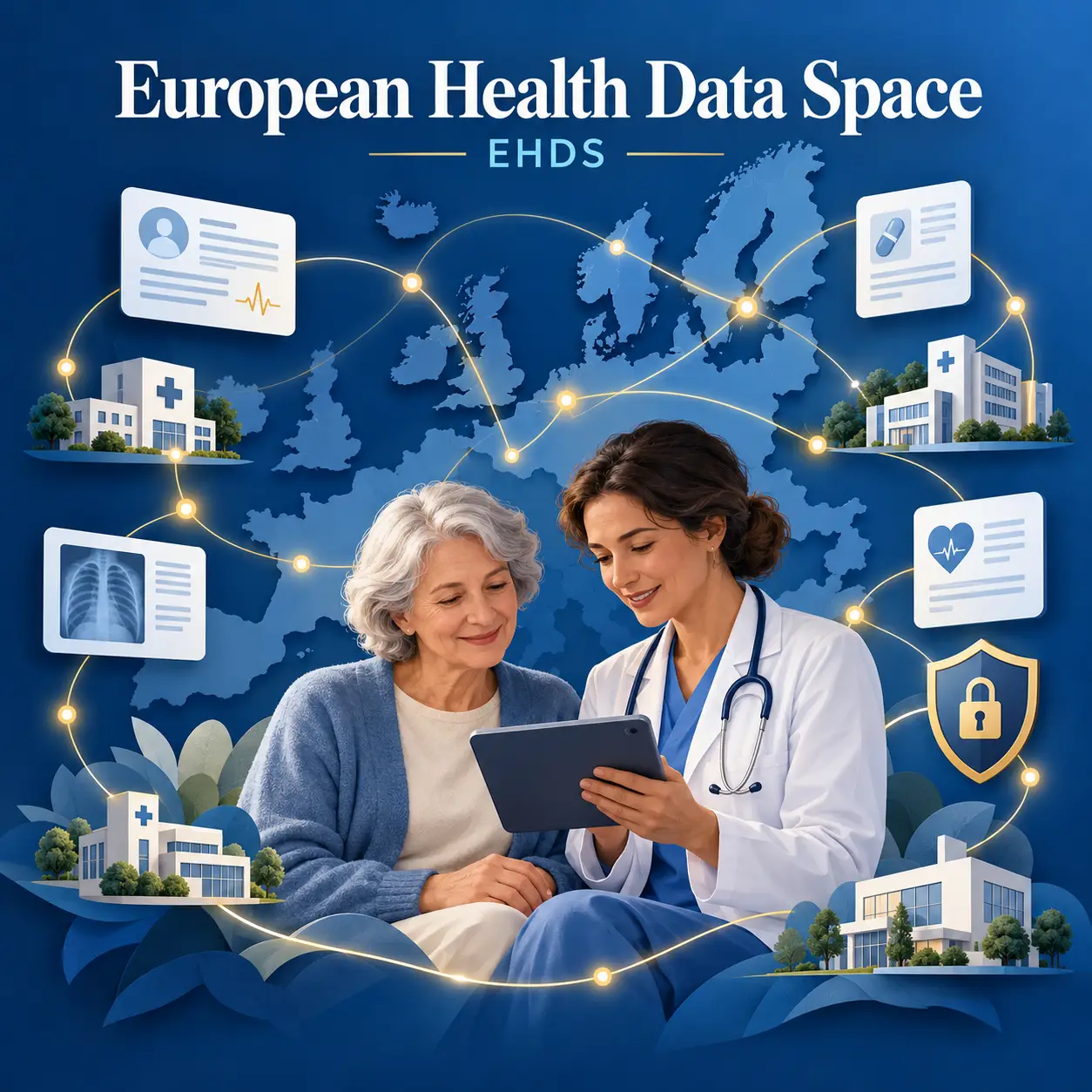
Across Europe, citizens’ health data remain scattered across systems, formats and storage media that often cannot communicate with one another.
When patients move between countries their medical information does not always follow them. This fragmentation can disrupt continuity of care and leave healthcare professionals without information needed to make informed treatment decisions.
The European Health Data Space (EHDS) aims to address these barriers through a common framework for the secure use and exchange of electronic health data. It seeks to strengthen individuals’ access to and control over their information, enable its reuse for research and other authorised purposes, and improve interoperability between electronic health record systems. The regulation entered into force on 26 March 2025, with major requirements taking effect progressively from 2029 and 2031.
For healthcare organisations, this transition raises questions that extend beyond regulatory compliance. It creates an opportunity to reconsider how clinical information is collected, organised and translated into better services.
Italy’s electronic health record, the Fascicolo Sanitario Elettronico, has helped establish the foundations for making patients’ clinical histories available digitally. However, the existence of digital records does not automatically ensure that information can be exchanged and across different organisations.
The EHDS extends this ambition to the European level. Relevant clinical information should be available to support care, reducing the information gaps that can arise when responsibility moves between professionals, organisations or countries.
Achieving this requires coordination between the institutions producing, managing and using health data. Digital infrastructure must develop alongside organisational practices that support reliable and secure information exchange.
Two are the main reasons why healthcare organisations should begin investing in their data ecosystems.
The first is regulatory preparedness. Although implementation will be gradual, developing the necessary infrastructure and organisational capabilities takes time. Healthcare providers need to assess their existing systems, identify weaknesses in data management and plan how to improve interoperability. Delaying this work could make the transition more difficult as implementation milestones approach.
The second is the opportunity to make better use of available information. Healthcare organisations have accumulated substantial volumes of clinical data, yet much of this material remains dispersed or difficult to analyse. Its potential contribution to service improvement and innovation is consequently underused.
From this perspective, preparing for the EHDS can become part of a broader effort to improve information management. The objective is to turn accumulated records into a dependable resource for clinical work, research and organisational learning.
Data quality is at the centre of the transition. Information must be produced and organised according to shared criteria so that it retains its meaning when exchanged between organisations. Technical connectivity alone cannot resolve differences in terminology, clinical coding or documentation practices.
Healthcare organisations also need clear responsibilities for maintaining data quality and managing access. Building an ecosystem involves connecting technologies while ensuring that the people and institutions using them can work together effectively. In doing so, clinical data repositories are essential because they bring together information generated by different local systems, helping healthcare providers organise, standardise and make it available for authorised uses.
Their value lies in reducing fragmentation within individual organisations and supporting exchange with wider networks. Information that is consistently organised at its source is better positioned to move between systems without losing its clinical meaning.
The intended value of a connected health data ecosystem lies in the improvements it could support in healthcare delivery. More coherent information could help professionals develop a fuller understanding of patients’ histories and needs, while creating opportunities for research and the development of new services.