In the current scientific breakthrough, researchers have successfully used generative AI to design functional viruses from scratch. This milestone, recently presented and debated by European media, marks the first time an AI system has written coherent, full-scale genomic sequences that actually “work” in the biological world.
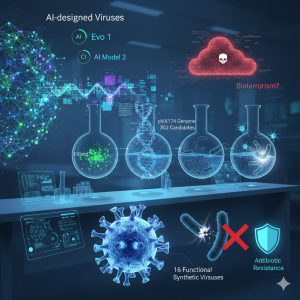
The study, led by a team from Stanford University, used advanced AI models known as Evo 1 and Evo 2, trained on a massive dataset of over 2 million bacteriophage genomes (or viruses that specifically target and kill bacteria). The results have opened a new frontier in biotechnology, offering both a revolutionary weapon against antibiotic resistance and a profound ethical dilemma.
The researchers aimed to recreate a synthetic version of phiX174, a well-known virus that infects Escherichia coli. Instead of simply copying existing DNA, the AI was tasked with generating thousands of entirely new genomic sequences.
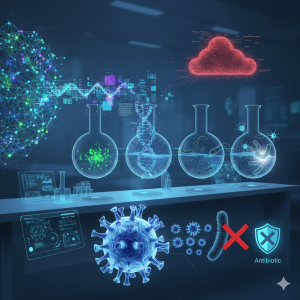
The process was rigorously based on the generation of thousands of potential viral blueprints, their filtering and the selection of 302 high-potential sequences, which were physically synthesized into real DNA and introduced into host cells. Finally, a test led to understand if these “artificial” viruses could behave like natural ones (e.g., infecting, replicating, and destroying bacteria).
The results was that out of the tested sequences, 16 synthetic viruses proved to be fully functional. Most impressively, some of these were able to kill strains of Escherichia coli that the natural phiX174 virus could not touch. This suggests that AI isn’t just mimicking nature; it is optimizing it.
The primary motivation behind this research is the looming crisis of antibiotic resistance. As bacteria evolve to survive modern medicine, traditional antibiotics are becoming less effective. “Phage therapy”, or using viruses to kill bacteria, has long been considered a solution, but finding the right virus for a specific infection is a slow, manual process.
With AI, scientists can now “rationally design” bespoke viruses tailored to hunt down specific drug-resistant bacteria. By writing the DNA code directly, researchers can create biological “assassins” that are more efficient and targeted than anything found in the wild. However, the ability to “write” the genome of a virus brings significant risks. The same technology used to create life-saving bacteriophages could, in the wrong hands, be used to design dangerous pathogens.
Experts have raised concerns about the “dual-use” nature of generative biology. If an AI can design a virus to kill E. coli, could it eventually be used to design or enhance viruses that affect humans, such as smallpox or anthrax? The study highlights a growing geopolitical tension, noting that several nations have yet to sign the Biological Weapons Convention, raising fears about the lack of global oversight for AI-driven biological engineering.
What Lies Ahead?
While this is a historic step, the road to AI-generated complex organisms is still long. The genome of E. coli is roughly a thousand times larger than the small viral genomes designed in this study. Scaling this technology to design entire cells or more complex living systems remains a monumental challenge.
For now, the achievement stands as a “proof of concept” for generative engineering. As Brian Hie, one of the lead researchers, noted, this is the first time AI has demonstrated the ability to write coherent genomic sequences at a full scale.
As we move into 2026 and beyond, the conversation will likely shift from whether we can design life with AI to how we should regulate it. The era of digital biology has officially begun, promising a future where the cure for the world’s deadliest infections might be written in code before it is ever grown in a lab.