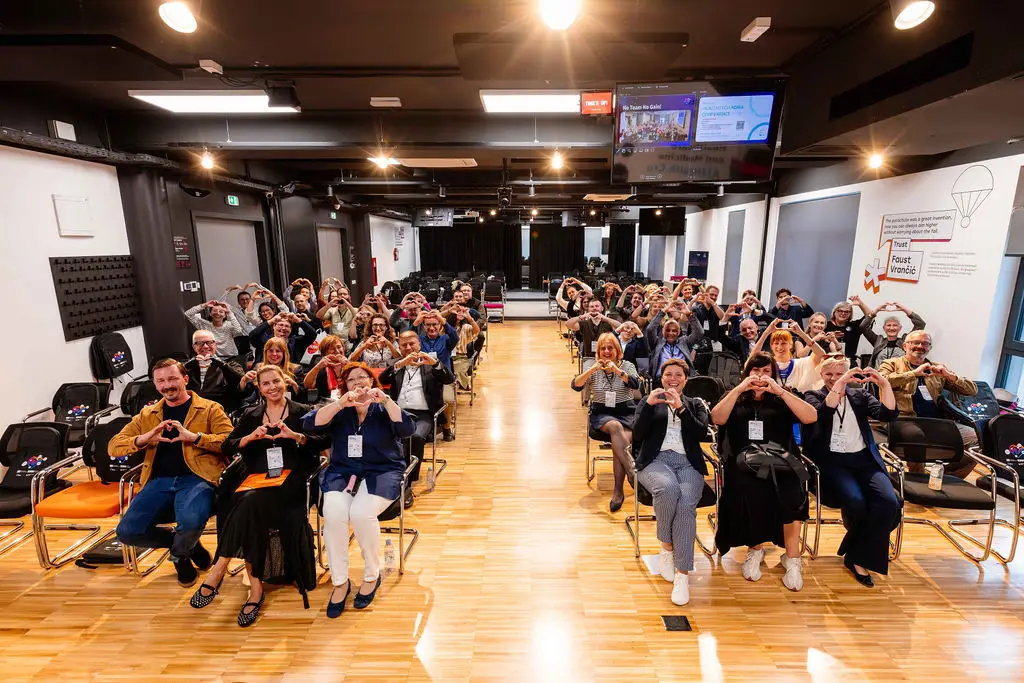
Artificial intelligence is increasingly becoming part of healthcare, but moving from a promising idea to real-world application requires much more than strong technology. Solutions need to be tested and validated, healthcare organisations need the right infrastructure, and the professionals expected to use these tools need the knowledge and skills to understand them.
This pathway from innovation to implementation was at the centre of the AI4Health.Cro Final Conference, held on 22 September 2026 at Algebra Bernays University in Zagreb. The conference marked the end of the first three-year phase of AI4Health.Cro, the European Digital Innovation Hub for Artificial Intelligence in Healthcare and Medicine coordinated by the Ruđer Bošković Institute.
Three years of bringing digital health solutions closer to practice
During its first three years, AI4Health.Cro delivered more than 2,000 digital transformation services to healthcare and technology organisations. These included around 100 test-before-invest activities, support for product development and investment readiness, as well as specialised training for 136 physicians. The hub worked with around 50 companies and 30 public-sector users, helping them overcome some of the challenges that often stand between a technological solution and its application in healthcare.
The conference showed what this support can look like in practice. Six users presented solutions at different stages of development, from early prototypes to products approaching commercialisation and solutions already available on the market.
SENDD, developed by TIS Grupa and Poliklinika Sabol, uses computer vision and machine learning to analyse spontaneous infant movements recorded by smartphone, supporting earlier recognition of neurodevelopmental risk. Curativa.ai, developed by IVTECH, is an AI assistant designed to analyse complex medical data in real time, provide concise evidence-based recommendations and automate selected administrative tasks. ResoluX, developed by Digicyte, uses sparse deconvolution to enhance the resolution of cytology images through a workflow connecting a microscope, camera and image-processing software.
PrivacyMark, developed by WERXE, helps healthcare organisations manage GDPR compliance and cybersecurity requirements by turning information about systems, equipment and suppliers into the documentation needed for compliance processes. EEYA, presented by Plasma Glow, is a functional prototype of a non-invasive home skincare device based on hybrid cold plasma technology. Finally, Mental Boost, presented by Psihološki centar Juranić, combines a short psychological self-assessment with personalised micro-interventions and guided self-help programmes; conference visitors could also try an existing 14-day programme developed within this approach.
Technology is only one part of the equation
The experience presented at the conference illustrates an important point: making an AI solution technically ready for healthcare is only one part of digital transformation.
The conference programme made this explicit. In a session titled Future-Ready Doctors: Building Digital Skills with the Croatian Medical Chamber, Ivan Bekavac, MD, Head of the Office for Professional Medical Affairs at the Croatian Medical Chamber, focused on a question no product demo can answer: are physicians prepared to work with these tools?
Successful adoption also depends on the people who develop, evaluate and use these technologies. Healthcare professionals need to understand the possibilities and limitations of AI, while technology specialists need a stronger understanding of the medical context in which their solutions will operate.
This is where the work of AI2MED complements initiatives such as AI4Health.Cro.
AI2MED focuses on bridging the AI skills gap in healthcare by equipping medical and data science professionals with knowledge and competences needed for the responsible use of AI. Its activities combine education, interdisciplinary collaboration and practical learning, with the broader aim of accelerating AI adoption while building trust in its use in medicine.
The recently launched AI2MED MOOCs reflect this approach. Their topics range from data management and cybersecurity to advanced digital competencies, interdisciplinary communication, and AI ethics and oversight – areas that become increasingly important as digital solutions move from development into real clinical environments.
Put simply, while initiatives such as AI4Health.Cro help make technology ready for healthcare, AI2MED contributes to making healthcare professionals and future specialists ready for AI.
Connecting projects, knowledge and communities
There is also a direct institutional connection between the two initiatives. Algebra Bernays University, the coordinator of the AI2MED consortium, and Smion, an AI2MED project partner, are joining the next phase of the AI4Health.Cro consortium. This creates additional opportunities to connect expertise in education, innovation support and healthcare technology across the two ecosystems.
The connection can also help extend the impact of AI2MED beyond the project itself. Organisations, healthcare professionals, innovators and other stakeholders engaged through the AI4Health.Cro ecosystem represent a relevant audience for further dissemination and uptake of AI2MED results, including its educational resources, training approaches and insights into the skills required for responsible AI adoption in medicine.
In this way, the two initiatives address different but closely connected parts of the same transformation: developing and validating better healthcare technologies on one side, and ensuring that people have the skills and interdisciplinary understanding needed to use them effectively on the other.
The next phase of AI-enabled healthcare will depend on both. Better technology alone is not enough, and neither is education disconnected from real implementation. Bringing these elements closer together is an important step toward healthcare systems in which AI can be tested, understood and applied responsibly.
This article is part of the AI2MED project, a larger initiative aimed at integrating AI into healthcare, improving diagnostics and treatments, and developing skills through educational programs and innovation. The article was written by Smion, a Croatian innovation agency and one of the project’s partners.