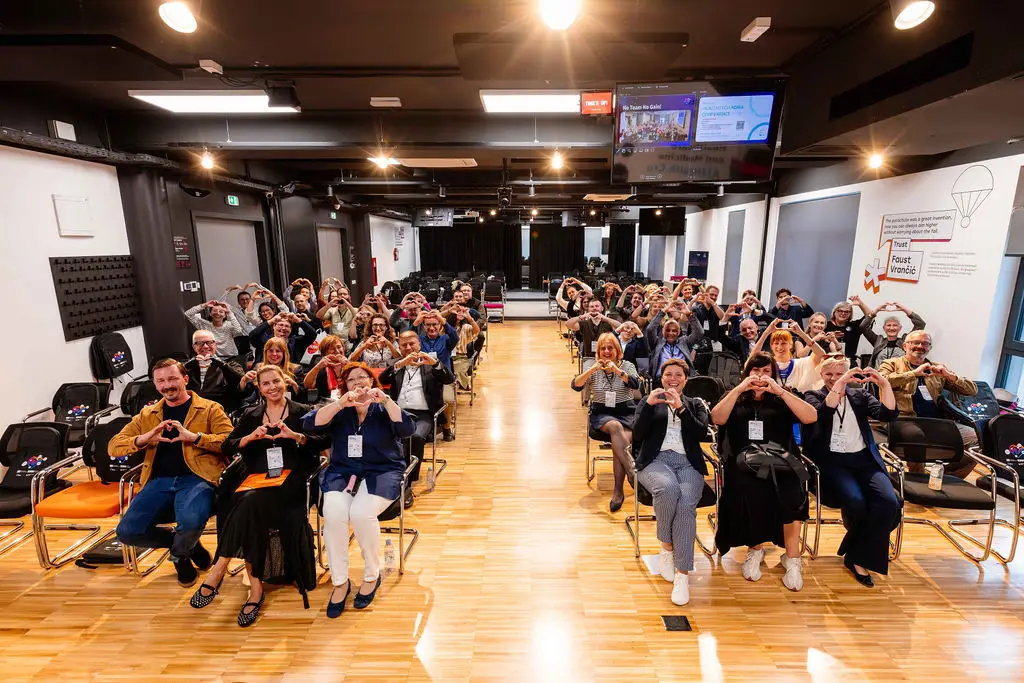
AI2MED is pleased to support ITIR Summit 2026, an interdisciplinary event taking place on 11 March 2026 in Pavia, which will bring together researchers, innovators, institutions, and professionals to reflect on some of the most urgent questions of our time. Organised by the Institute for Transformative Innovation Research (ITIR) at the University of Pavia, this year’s summit is titled “Red Flashes” and invites participants to consider a provocative question: “How far can science, technology, and society go before crossing boundaries that call for new forms of responsibility?”
According to the official programme, the 2026 edition moves beyond the sense of wonder usually associated with scientific frontiers and shifts the focus toward the responsibility of decision-making in research. The summit connects themes such as energy, technology, demography, and human experience, exploring how innovation can extend life, transform systems, and expand human capabilities, while at the same time raising complex ethical, social, and scientific challenges. This makes the event especially relevant to AI2MED, whose mission is to foster the responsible integration of artificial intelligence into healthcare, education, and clinical practice.
In addition to scientific discussion, the programme includes networking opportunities, audience interaction, and cultural moments designed to make the event both engaging and memorable. This blend of research, public communication, and live performance reflects a contemporary understanding of science as something that should be discussed not only within academic circles but also with society.
The summit unfolds through three major thematic acts. The first, “Red Health – Parliament of Longevity” (Rosso salute – Parlamento della Longevità), focuses on the opportunities and limits of longer lives. It addresses not only biomedical progress but also the broader implications of longevity for prevention, healthcare systems, social equity, advanced robotics, ageism, and the silver economy. This theme is particularly relevant to the AI2MED community, as it highlights the growing importance of prevention, healthy lifestyles, and person-centred health strategies in an era increasingly shaped by digital tools and AI-supported care.
The second act, “Red Energy – Agora of Impossible Forces” (Rosso energia – Agorà delle Forze Impossibili), turns to another major question: how far should societies go in pursuing prosperity, security, and sustainability through new energy pathways? The session addresses the tension between renewable transitions and more controversial or “extreme” sources, including clean nuclear energy, reopening the debate on the costs, trade-offs, and responsibilities associated with scientific and technological progress.
The third act, “Red Passion – Laboratory of Augmented Emotions” (Rosso passione – Laboratorio delle emozioni aumentate), examines a frontier that is especially relevant to artificial intelligence: whether technology can truly decode and reproduce emotions, or whether it can only simulate them. The programme underlines the importance of a human-in-the-loop approach, presenting it not merely as a mechanism for quality control but as a safeguard for human consciousness, identity, and lived experience. This perspective is closely aligned with AI2MED’s commitment to ensuring that AI enhances healthcare without replacing the human dimensions of care, empathy, and professional judgement.
The afternoon will continue with parallel in-depth sessions hosted at the University of Pavia, each dedicated to a specific topic. These include discussions on overcoming myths and limits of AI, innovation governance, and finance in the age of longevity, as well as the particularly relevant session “Digital Red Blood Cells: A Study on Physicians Augmented by AI.” Another session of clear interest is “Living Red: Longevity, Health and Lifestyle” (Rosso Vivo: Longevità, salute e stile di vita). Together, these themes strongly resonate with AI2MED’s vision: preparing health professionals for a future in which digital tools, clinical expertise, and preventive approaches must work together in a responsible, effective, and human-centred way.
By granting its support, AI2MED recognises ITIR Summit 2026 as a valuable space for interdisciplinary dialogue on issues that are central to the project: AI in healthcare, innovation governance, human-centred transformation, and the future of professional skills. At a time when medicine is being reshaped by data, algorithms, and new forms of decision support, events such as this help build the shared language needed across academia, healthcare, technology, and society.