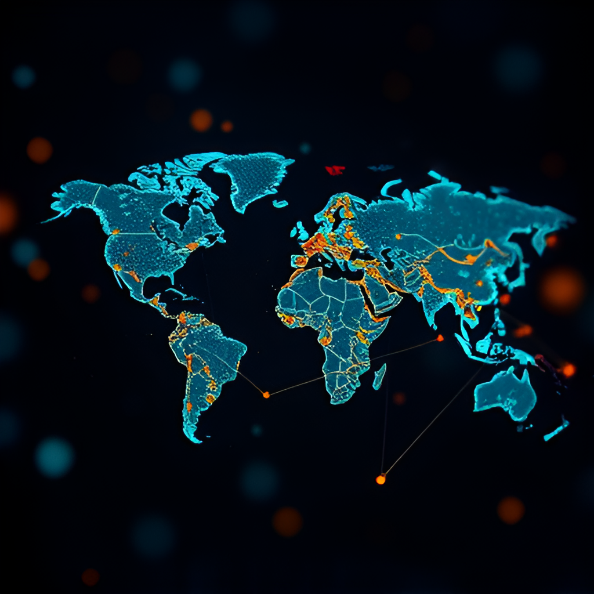
Artificial intelligence, or AI, is in the headlines for its groundbreaking uses across many sectors, and in public health, its impact is nothing short of revolutionary. Recent breakthroughs have recognised that AI can solve some of medicine’s greatest challenges, from early disease diagnosis to pandemic readiness.
The Emergence of AI-Disease Surveillance
It was a global alert to the pandemic of COVID-19 initially caused not by a human, but a computer. HealthMap, a Boston Children’s Hospital site, uses artificial intelligence to scan social media, news stories, web search queries, and other data streams for signs of disease outbreaks. On 30 December 2019, the data-mining tool detected an initial news report on novel pneumonia in Wuhan, China, demonstrating the ability of AI to raise significant early warnings for emerging health threats.
Similarly, a Canadian startup company, Blue Dot, was the first to notify of the outbreak of an infectious respiratory illness even before the authorities announced COVID-19. AI systems screen massive amounts of unstructured social media, news articles, and other data sources, filtering for patterns that can indicate outbreaks of disease, often detecting risk days or weeks ahead of traditional surveillance methods.
Global Health Organisations Lead the Way
The World Health Organisation (WHO) has synchronised AI at the center of its future public health strategy. WHO intends to develop digital frontiers and bring up an AI ecosystem for security, equity, and assistance to the Sustainable Development Goals, resulting in a healthier world. This is a growing recognition that AI technologies are unavoidable in addressing global complex health threats.
Artificial intelligence could rapidly scan large and complex sets of data, generate recommendations, assist decision-making, and increase the efficiency of many activities involving data, text, or image processing. AI thus has the capacity to revolutionise public health practice and research but with it come challenges that need to be addressed.
Real-World Applications Shaping Healthcare
The U.S. Centers for Disease Control and Prevention (CDC) has spent significant amounts to invest in AI capabilities to explore new applications including predictive modeling of opioid overdose death trends from heterogeneous data sources, large language model syndromic surveillance, and application of natural language processing methods to foodborne outbreak data to discover possible outbreak sources.
AI’s scope is also to automated diagnostic processes, increasing speed and accuracy in surveillance by automatically detecting tuberculosis from chest X-rays and accelerating outbreak response to Legionnaires’ disease by automatically detecting cooling towers from aerial images. These applications indicate how AI is transforming public health to be more responsive, accurate, and fair.
Pandemic Preparedness and Response
The COVID-19 pandemic served as the testing ground for applications of AI in public health. AI systems were able to reduce risks of human-to-human transmission by testing, analysis, and triangulation of infectivity and spread behaviour from available data.
High-priority applications that were realised included border management and risk assessment systems that picked up on asymptomatic infected travellers more effectively than random screening, natural language processing-based monitoring of vaccine safety to screen large amounts of text for potential safety signals, and AI chatbots for 24/7 care to populations that seek health information.
Building Systematic Implementation
Public health agencies are developing end-to-end approaches to AI deployment. There are six highest-ranked priorities to enable the effective use of AI technologies: contemporary data governance, investment in new data and analytic infrastructure, closing workforce skill gaps, developing strategic collaborative partnerships, applying good AI practices for transparency and reproducibility, and overt equity and bias consideration.
The CDC’s 2025-2026 Public Health Data Strategy also reflects this consideration framework, with plans to define and build collective AI capability on the strength of 2024 AI application learnings, evidence-based demonstration of growth in AI applications.
Addressing Challenges and Ensuring Equity
While promising, AI adoption in public health has substantial challenges. The technology can amplify health inequalities and ethical issues if not well addressed. Some of the major issues include data quality and bias, algorithmic transparency, and access to AI-based health tools for equitable use.
To mitigate these threats, strategic action includes the collection of data from diverse population subgroups to provide sufficient representation in human variability for AI systems, design of AI for results that are explainable so that users will be able to understand and have faith in decisions made, and accountability in AI operations.
The Future of Public Health
As technology improves, however, the potential of AI in public health has only just begun to materialise, said experts. A poll of leading public health officials listed AI as the single biggest potential to improve public health, enabling policymakers to make public health with faster speed, precision, and efficiency, as new diseases emerge more rapidly and climate change increases health threats.
Public health practice is poised on the cusp of a paradigm shift based on recent developments in artificial intelligence. The shift will usher in a new means of carrying out public health activities, addressing gaps achieved through the COVID-19 pandemic and managing investments put in place to meet twenty-first century demands.
The integration of AI into public health systems is more than a technological advancement—it has the potential to create more responsive, accurate, and equitable health protection for populations around the world. As global health challenges become increasingly complex, AI only waits to be challenged as a capable aid in delivering public health for future generations.
Reference
- The Lancet Public Health. (2025). “Artificial intelligence in public health promises, challenges, and an agenda for policy makers and public health institutions.” The Lancet Public Health, Vol. 10, No. 5.
- World Health Organization. (2025). “Harnessing artificial intelligence for health.” WHO Digital Health and Innovation.
- American Journal of Public Health. (2025). “The Way Forward to Embrace Artificial Intelligence in Public Health.” AJPH, Vol. 115, Issue 2.