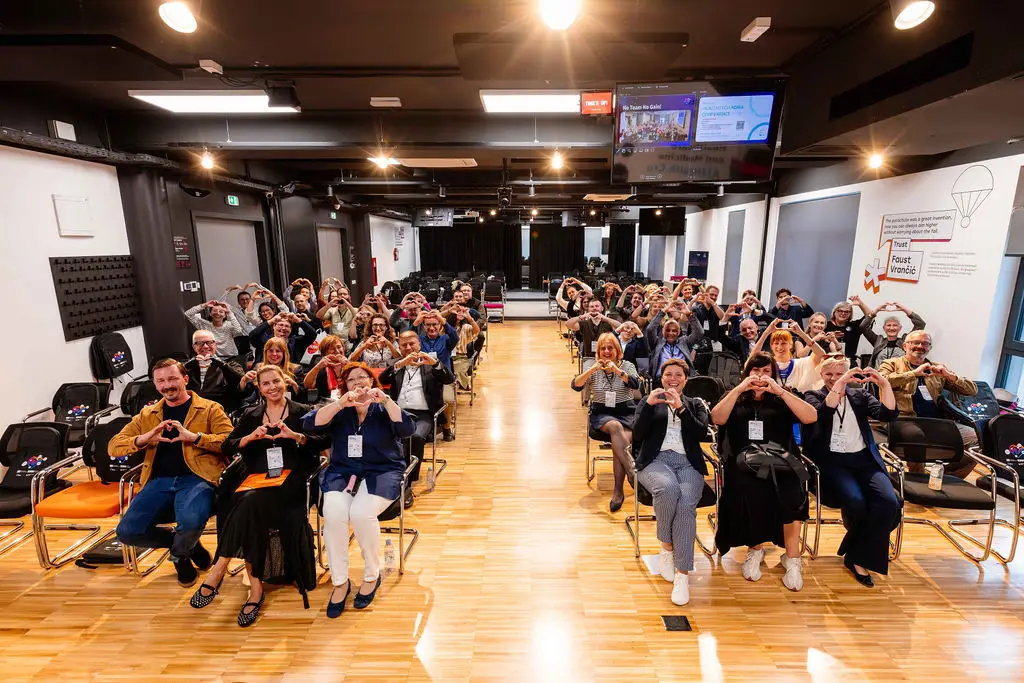
The University of Pavia, with Dr Rachele De Giuseppe, participated in the 47th SIME Congress in Rome (Aesthetic Medicine Decoded – From AI to Ethical and Sustainable Beauty; 15-17 May 2026), contributing to the intersociety session “Nutrition, Wellness and AI” with a presentation on the European project AI2MED.
The session formed part of a broader scientific programme that identified AI as a key theme for the future of medicine, professional development and patient-centred care.
The SIME Congress is one of the main annual events of the Italian Society of Aesthetic Medicine, promoting scientific exchange, multidisciplinary dialogue and innovation in clinical practice.
The 2026 edition explicitly addressed the role of emerging technologies, including AI, in diagnosis, treatment planning and therapeutic evaluation, while emphasising the need for ethical guidance and the preservation of the doctor–patient relationship. Within this context, the University of Pavia delivered the lecture “AI2MED: bridging the skills gap for more accurate, efficient, and reliable healthcare”, highlighting how artificial intelligence is already transforming medicine and why its safe and responsible adoption depends primarily on education, governance and shared competences.
The lecture opened with a reflection on the current relevance of AI in healthcare. Medicine is increasingly shaped by large, heterogeneous datasets: electronic health records, diagnostic images, genomic data, laboratory tests, wearable devices, remote monitoring systems and patient-generated information. AI can help transform this growing volume of information into usable knowledge by recognising patterns, supporting clinical decision-making, stratifying risk, personalising treatments and improving the efficiency of care pathways. However, the presentation emphasised that AI should not be framed as a replacement for clinical reasoning. Rather, it should be considered a form of augmented support: a “second look” that can expand the clinician’s ability to interpret complex information, while leaving responsibility, judgement and contextual interpretation firmly in the hands of healthcare professionals.
A central message of the talk was that the real challenge is not only technological, but educational, cultural and organisational. AI is rapidly entering healthcare systems, but many professionals still lack the skills to critically assess AI-based tools. At the same time, many data scientists and technology developers do not receive sufficient training in the clinical context in which their algorithms will be used. This creates a two-sided skills gap: healthcare professionals need stronger data literacy, while data scientists need stronger medical literacy. The lecture, therefore, emphasised that physicians do not need to become programmers, but they must be able to understand how AI systems work, what data they use, in which populations they have been validated, what limitations they present and under which conditions they may fail. Conversely, data scientists must understand that clinical data are often complex, incomplete, context-dependent, and linked to decisions with ethical, legal, and human consequences.
This is precisely the space in which AI2MED operates. During the presentation, the University of Pavia outlined AI2MED’s five main objectives as a progressive pathway from individual competence to ecosystem building. The lecture also showcased the public outputs already developed by the consortium, demonstrating that AI2MED does not merely state that new competences are needed; it proposes practical tools to teach, share and apply them. The project therefore moves from theory to implementation, supporting learning pathways that integrate medicine, data science, ethics, regulation and clinical application.
A further key point concerned trust. The presentation argued that trust in AI cannot be built by algorithms alone. It requires transparency, validation, explainability, attention to bias, privacy protection, clear accountability, and meaningful involvement of patients and citizens. In medicine, an algorithmic error is not only a technical problem: it may become a clinical, ethical, and medico-legal issue. For this reason, AI adoption must be accompanied by appropriate governance and by professionals capable of asking the right questions: Where can AI be useful? What risks must be managed? What competences are needed to use it responsibly?
The University of Pavia’s participation in SIME provided an important opportunity to convey the AI2MED message to a medical audience engaged in the evolving relationship among nutrition, wellness, technology and person-centred care. The intersociety session “Nutrition, Wellness and AI” confirmed that AI is no longer a distant future scenario but a present component of healthcare innovation. The scientific programme included several sessions dedicated to Nutrition, Wellness and AI, reflecting the growing relevance of these topics across clinical and preventive medicine. Therefore, the take-home message of the presentation was clear: the future of AI in medicine will not depend solely on the power of algorithms or the quantity of available data, but on the quality of the competences, relationships and governance structures that support their use. AI can help healthcare become more accurate, efficient and trustworthy only if professionals are prepared to integrate it critically, safely and responsibly into clinical practice. In this perspective, AI2MED contributes to a European educational and cultural transition: from passive exposure to AI tools to informed, collaborative and responsible adoption for the benefit of patients, healthcare systems and society.